
Everyone has their own way of stoking the fires of creativity for their writing, or other artforms. Some have a need to participate in new experiences (legal or otherwise) to give them inspiration. It stimulates something in their brain that opens up a new pathway.
Others find less adrenaline-pumping ways of opening new doors. That’s likely closer to my camp. But I’m always looking for tools, new or reminders of established ones, that can help open up new thoughts.
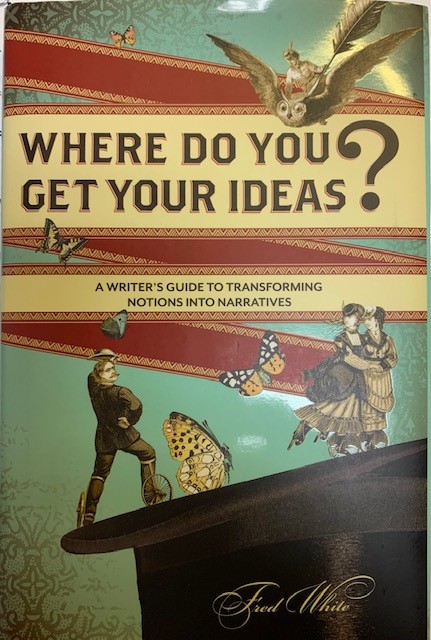
My memory was jogged by one such book I rediscovered “Where Do You Get Your Ideas,” (2012) by Fred White. Free Associating is an exercise that gets your mind out of the shackles of following the same beaten paths.
Free-associating on paper may seem like junk writing, and in a sense it is. You’re not writing for an audience
Fred White
Author Where Do You Get Your Ideas?
One version is a little like the familiar psychologist game. The one where the doctor says a word, and the patient says the first word that comes to mind. Except, here you take a word like escape and you think of all the words or phrases that you can connect to it.
This could induce you to write down words like wilderness, prison, relationship, lousy job, motherhood…or any situation from which one might want to break loose.
You can also do it visually. Take a busy airport. In between your dash between gates and waiting for boarding calls, free-associating can be ignited by hearing conversations, seeing different items coming out of backpacks, or maybe a t-shirt that someone is wearing in the terminal.
They cause us to make other unique connections that could be a seed of creativity.
Author Fred White puts it well in this book by saying, “Free associating on paper may seem like junk writing, and in a sense it is. You’re not writing for an audience, nor are you even writing for yourself. Instead, you’re writing to break through the shell of restraint, of fear, of uncertainty…”
He also warns that while you do this, don’t try to edit yourself as you go along. You’ll do that later. Just write the ideas down. No one will see them, but you. Premature editing at this stage will make it twice as hard, it won’t be fun, and will likely produce uninspiring ideas leading to dead-fish writing…lifeless and stinky.
I think it’s a fun way of revving up the writing engine…especially if you find yourself sputtering down the road.
This book is an easy read and I’ve marked mine up pretty quite a bit. It’s about $5 these days on Amazon and is published by Writer’s Digest. CLICK HERE FOR A LOOK

Steve Linscomb is a former television news reporter with more than 25 years experience in a number of small and large U.S. TV markets. His focus is in the development of the craft of fiction writing, more specifically historical fiction in both reading and in his current personal writing efforts.
He lives in San Antonio, Texas.

 My Storm Farm